

It’s 7 PM. Dinner is on the table. You say “last five minutes” for the third time — and your four-year-old goes from happy to howling in under ten seconds.
If that sounds like your evening, you’re not doing anything wrong. And your child isn’t being difficult on purpose.
Here’s the part most screen-time advice misses: the fight is almost never about the screen. It’s about the stop. A young brain in the middle of a cartoon is fully absorbed — and being yanked out of it feels sudden and unfair. Fix the stopping, and you’ll cut most of the fights without cutting a single extra minute.
Why “five more minutes” makes it worse
Toddlers and preschoolers don’t have a sense of clock time. “Five minutes” means nothing to a three-year-old. What they hear is: the good thing is ending soon, and I don’t know when. So they brace for it — and fight the moment it comes.
Worse, most of us don’t stick to it. We say five, get busy, and it becomes fifteen. The child learns that protesting buys extra time. That’s not manipulation; that’s a smart kid noticing a pattern.
What to do instead: make the ending visible and non-negotiable before the screen goes on.
1. Decide the ending before you press play
Before handing over the tablet, say out loud: “Two episodes, then we wash hands for dinner.” Then set a kitchen timer or a sand timer the child can see. A visual countdown does something a verbal warning can’t — it puts the ending outside of you. The timer is the bad guy, not amma.
Give a heads-up at the halfway point and again at one minute: “One more song, then the timer beeps.”
2. Always name what comes next
“Screen off” is a loss. “Screen off, then we go to the balcony to water the plants” is a swap.
Children resist an empty gap far more than they resist a change. Having the next thing ready — blocks already out, bathwater already running, an older sibling waiting to play — turns the transition into a move rather than a stop. Keep a small set of “landing activities” that require zero setup: stacking cups, stickers, play dough, a bucket of water and a paintbrush on the balcony floor.
3. Make some places screen-free, not some times
Time-based rules (“only after 6 PM”) invite negotiation every single day. Place-based rules don’t. No screens at the dining table. No screens in the bedroom. No screens in the car for short trips. Children absorb place rules quickly because they’re consistent and easy to remember. Nobody argues about whether the table is the table.
This one rule alone usually removes two or three flashpoints a day.
4. Watch the first ten minutes with them
You don’t need to sit through the whole thing. But watching a few minutes and asking one question afterwards — “Why was the elephant sad?” — changes screen time from a solo trance into a shared activity. Children who talk about what they watched are far easier to pull away from it, because the conversation becomes part of the fun.
It also tells you what they’re actually watching. Autoplay is very good at drifting from a gentle rhyme video to something loud and frantic within twenty minutes. That shift in content is often what shows up later as a shorter fuse at bedtime.
5. Check your own phone first
This is the uncomfortable one. Children copy what they see, not what they’re told. If the phone is in your hand through dinner, “no screens at the table” won’t survive long.
Try one simple thing: a charging spot near the door where everyone’s phone lands from 6 to 8 PM. You don’t have to be perfect. You just have to be visibly trying — children notice that too.
6. Expect the meltdown anyway, and stay boring
Some days the timer beeps and your child still falls apart. That’s normal. Two- to five-year-olds are still building the brain machinery for self-control, and it’s exhausting work for them.
When it happens: get low, name the feeling (“You really wanted to finish that, it’s hard to stop”), and hold the rule. Don’t lecture, don’t bargain, don’t give the screen back to end the crying. Being calm and slightly dull is the fastest exit. If you give in once out of tiredness, you’ve taught the lesson that big enough crying reopens the decision.
What good structure looks like elsewhere
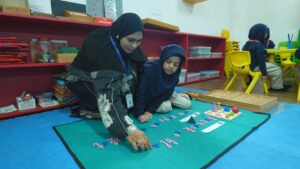
There’s a reason children who fight screen limits at home often follow them easily at preschool. It isn’t stricter teachers — it’s rhythm. A predictable sequence of circle time, free play, snack, outdoor play means a child always knows what’s coming next, so transitions stop feeling like losses.
That’s exactly what we build into the day at Brainy Stars, Koramangala — structured play, hands-on activity and real conversation instead of screens. Parents at our HBR Layout preschool often tell us the first change they notice at home is smoother evenings, because the child is already used to a rhythm. The same approach runs through our Bismillah Nagar campus, where a lot of screen time gets replaced simply by having something more interesting to do.
You can borrow the idea at home. A loose, repeated evening order — snack, play, screen, bath, dinner, story — does more for screen-time peace than any number of rules.
Start with one change this week
Don’t overhaul everything. Pick one:
- Set a visible timer before the screen goes on
- Make the dining table screen-free
- Name the next activity every single time
Give it seven days. Most parents notice the arguments getting shorter before they notice the screen time getting smaller — and that’s the win that actually matters.
Want to see how a screen-free, play-led day works in practice? Book a campus visit at Brainy Stars — Koramangala, HBR Layout or Bismillah Nagar — and watch a session for yourself.