
By Brainy Stars International Holistic Montessori & School
Watch a toddler with a bowl of water and a few cups. They pour, splash, squeeze, and stare. To an adult it looks like a mess in the making. To the child, it is research.
Young children do not learn the w
orld through explanations. They learn it through their senses: touching, tasting, smelling, listening, looking, and moving. This is why sensory play is at the heart of early childhood education, and why it matters so much in the first years of life.
What Is Sensory Play?
Sensory play is any activity that engages one or more of a child’s senses. It includes the familiar five (touch, sight, hearing, smell, and taste) as well as two lesser-known ones: movement and balance, and body awareness.
Examples include playing with sand, clay, or water, sorting dried beans, smelling herbs and flowers, listening to different sounds, and walking barefoot on grass.
Why Sensory Play Matters
1. It builds the brain
Every new sensory experience creates connections between nerve cells in a child’s brain. The more varied the experiences, the stronger and richer these pathways become. This forms the foundation for later learning, including language, math, and problem-solving.
2. It develops language
When a child squeezes wet sand, they learn words like cold, rough, heavy, and sticky in a way no flashcard can match. Sensory play gives children a reason to describe what they feel, and gives parents and teachers natural moments to introduce new vocabulary.
3. It strengthens fine and gross motor skills
Pinching, scooping, pouring, and threading build the small hand muscles needed for writing and buttoning a shirt. Climbing, balancing, and carrying build whole-body strength and coordination.
4. It supports emotional regulation
Soft textures, gentle sounds, and repetitive movements such as pouring or kneading can calm an overwhelmed child. Sensory activities give children a safe way to work through big feelings.
5. It encourages curiosity and independence
Sensory play has no single right answer. Children choose what to do, test ideas, and see what happens. This builds confidence, patience, and the habit of asking what if?
Sensory Play in the Montessori Classroom
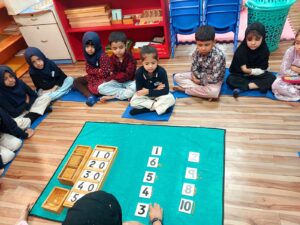
In the Montessori approach, sensory learning is a core part of the curriculum. Children work with specially designed materials that isolate one quality at a time, such as size, weight, texture, color, or sound. A child might match rough and smooth boards, grade cylinders by size, or match sound boxes by their pitch.
Because each material focuses on one idea, children learn to notice differences, compare, and classify. These are the same skills they will later use in reading, math, and science.
Easy Sensory Play Ideas to Try at Home
You do not need expensive toys. Everyday items work well.
- Water play: Give your child cups, spoons, and a tub of water for pouring and scooping.
- Sensory bins: Fill a tray with rice, lentils, or pasta and hide small objects to find.
- Playdough and clay: Rolling, squeezing, and shaping builds hand strength.
- Nature walks: Collect leaves, stones, and flowers, and talk about how each feels and smells.
- Kitchen exploration: Let your child smell spices, feel different fruits, and help wash vegetables.
- Sound games: Fill containers with different items and shake them to guess what is inside.
Tips for Parents
- Supervise closely. Small items can be a choking hazard for very young children.
- Embrace the mess. Lay down a mat or play outdoors so you can relax.
- Follow your child’s lead. If they love water, stay with water. If they dislike a texture, do not force it.
- Talk about it. Describe what your child is doing and ask open questions: How does it feel? What do you think will happen?
Final Thoughts
Sensory play is not an extra. It is how children make sense of the world. Every scoop, squeeze, and splash helps build a brain that is curious, capable, and ready to learn.
At Brainy Stars, our Montessori-based holistic approach gives every child plenty of hands-on, sensory-rich experiences that nurture curiosity and a lifelong love of learning. If you are looking for a preschool in Bangalore where your child can explore the world through play, we would love to welcome you for a visit.