
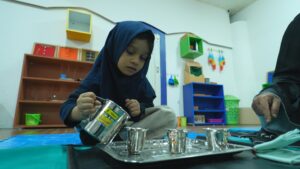
“I can’t tie my shoelace.” “I can’t do this puzzle.” “I can’t talk to that boy.”
If you’re a parent in Bangalore, chances are you’ve heard some version of “I can’t” from your little one this week alone. It’s one of the most common phrases in early childhood — and one of the most important ones to respond to well. How we react in that moment shapes whether a child grows into someone who avoids challenges or someone who leans into them.
The good news? Confidence isn’t a personality trait some kids are born with and others aren’t. It’s a skill, built through small, repeated experiences of trying, struggling, and succeeding. And the early years, roughly ages 2 to 6, are the best window to build it.
At Brainy Stars, we work with hundreds of Bangalore families every year, and we see the same pattern again and again: children who are given the right kind of support at home and in preschool start replacing “I can’t” with “I’ll try” — and eventually, “I’ll do it.” Here are seven practical, real-world ways to help your child get there.
1. Let Them Struggle a Little Before You Step In
Every parent’s instinct is to jump in and fix things — zip the jacket, finish the puzzle, answer for them when they hesitate. But a child who never struggles never learns that struggle is survivable. The next time your child says “I can’t,” pause for ten seconds before helping. Ask, “What have you tried so far?” instead of taking over. That small gap is where problem-solving muscles grow.
2. Praise the Effort, Not Just the Outcome
“You’re so smart” tells a child that ability is fixed. “You worked really hard on that” tells them effort pays off — and effort is something they control. Bangalore’s competitive academic environment makes it tempting to praise grades and results only. Try instead to notice the process: the third attempt at stacking blocks, the patience during a tricky worksheet, the courage to raise a hand in class.
3. Give Them Real Responsibilities at Home
Confidence grows when children feel useful, not just entertained. Simple, age-appropriate chores — watering a plant, setting the table, packing their own school bag — send a clear message: “You are capable.” Start small and let the responsibility grow as your child does. Completing a task, even an imperfect one, builds a quiet inner belief of “I can do things that matter.”
4. Normalise making mistakes openly.
Children watch how adults handle failure more than they listen to what adults say about it. When you spill something or make an error, say it out loud calmly: “Oops, I made a mistake. Let me fix it.” This models that mistakes are a normal part of doing things, not something to be ashamed of. Over time, kids who see mistakes handled calmly stop fearing them — and stop avoiding new challenges to dodge them.
5. Create Low-Stakes Chances to Be Brave
Confidence doesn’t build in one big leap; it builds in dozens of small, safe risks — ordering their own food at a restaurant, introducing themselves to a new friend at the park, trying a new slide at the playground. Look for everyday, low-pressure moments where your child can push slightly outside their comfort zone. Each small win becomes proof they can handle bigger ones later.
A structured, nurturing preschool environment plays a huge role here too. At our best preschool in Koramangala, children are gently encouraged to try new activities — from art to group play — in a setting designed to make “trying” feel safe rather than scary.
6. Avoid Comparing Them to Other Children
“Why can’t you be like Aarav, he already knows his alphabets” is one of the most common confidence-crushers, and most parents don’t even realize they’re saying it. Comparison teaches children to measure worth against others instead of their own progress. Instead, compare your child to their own past self: “Look how much better you are at this than last month!” That’s the comparison that actually builds self-belief.
7. Choose an Environment That Reinforces the Message
Confidence-building at home can only go so far if a child spends their days in an environment that undermines it — one that’s overly strict, results-obsessed, or doesn’t make space for individual pace. The right preschool acts as a partner in this journey, reinforcing everything you’re building at home through play-based learning, encouragement, and patient guidance.
Parents across HBR Layout often tell us this is exactly what drew them to our best preschool in HBR Layout — a place where children are met at their own developmental pace instead of being pushed or compared.
The “I’ll Do It” Moment Is Closer Than You Think
Building confidence in young children isn’t about grand gestures. It’s about hundreds of small, consistent moments — a pause before helping, a comment that praises effort, a chore done imperfectly but independently. Do this consistently, and one day you’ll hear it: not “I can’t,” but “I’ll do it” — said with a spark of pride that tells you the shift has already begun.
If you’re looking for a preschool in Bangalore that treats confidence-building as seriously as academics, we’d love for you to visit us. Families near Bismillah Nagar have found this balance of warmth and structure at our best preschool in Bismillah Nagar, where every child’s small wins are celebrated on the way to bigger ones.