
Every parent has watched their child get fascinated by something completely ordinary — stacking cups, sorting buttons, pouring water from one glass to another — and wondered, “Why won’t they just move on to the next activity?” The answer lies in one of early childhood education’s most respected philosophies: the Montessori approach.
At Brainy Stars, we’ve built our entire teaching philosophy around this simple but powerful idea — children learn best when they’re allowed to learn at their own pace, in their own way, guided (not pushed) by a prepared environment and attentive educators.
What Exactly Is the Montessori Approach?
Developed by Dr. Maria Montessori over a century ago, this method is built on one core belief: children are naturally curious and capable of driving their own learning when given the right environment. Instead of a one-size-fits-all curriculum where every child does the same worksheet at the same time, Montessori classrooms offer a range of hands-on activities that children can choose from — based on what genuinely interests them that day.
This isn’t about letting children “run wild.” It’s a carefully designed system where freedom and structure work together. Teachers observe closely, step in when needed, and gently guide children toward activities suited to their developmental stage — without forcing a rigid timeline on them.
Why “Their Own Pace” Actually Matters
Traditional preschool models often expect every three-year-old to master the same skill in the same week. But real learning doesn’t work that way. Some children pick up letters quickly but need more time with numbers. Others are naturally drawn to practical life skills like pouring, buttoning, or sweeping before they show interest in reading readiness.
When children are rushed through milestones, two things tend to happen: they either lose confidence because they feel “behind,” or they lose interest because they’re bored waiting for the group to catch up. The Montessori approach avoids both traps by letting each child move forward the moment they’re ready — not when the calendar says so.
This is especially crucial in the foundational years between ages 2 and 6, when a child’s sense of confidence and love for learning is being shaped for life.
The Core Pillars of a Montessori Classroom
- The Prepared Environment
Everything in a Montessori classroom — from the shelf height to the size of the furniture — is designed for the child, not the adult. Materials are displayed at eye level, easy to reach, and organized so children can independently choose, use, and return them. - Hands-On, Self-Correcting Materials
Montessori materials are designed so children can see their own mistakes and correct them without needing an adult to point it out. A puzzle piece that doesn’t fit, a tower that topples — these become natural learning moments rather than failures. - Mixed-Age Classrooms
Younger children learn by watching older ones, and older children reinforce their own understanding by helping younger peers. This mirrors real family and community dynamics far better than same-age-only groupings. - The Role of the Teacher as a Guide
In a Montessori setting, the teacher isn’t standing at the front lecturing. She’s observing, offering materials at the right moment, and stepping back to let the child work through challenges independently.
How This Looks at Brainy Stars
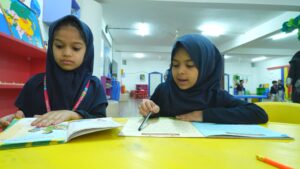
At Brainy Stars, we bring these Montessori principles to life through a warm, structured, and genuinely child-first environment. Our classrooms are designed to spark curiosity — whether a child gravitates toward practical life activities, sensorial exploration, early math concepts, or language development, they’re given the time and materials to explore it fully.
Our teachers are trained to observe rather than direct, ensuring that every child’s individual pace and interests are respected. This means a child who needs three weeks with a particular activity gets three weeks, and a child who’s ready to move ahead isn’t held back either.
Parents often tell us the biggest difference they notice isn’t just academic — it’s confidence. Children who are given the freedom to explore at their own pace tend to develop a stronger sense of independence, better problem-solving instincts, and genuine enthusiasm for learning, rather than learning becoming something they’re forced to do.
Choosing the Right Preschool for Your Child
If you’re a parent currently researching preschools, it’s worth asking any school you shortlist: Does your classroom let my child choose their own activities? How do you handle a child who’s slower or faster than their peers? The answers will tell you a lot about whether the philosophy is truly child-centered or just uses the word “Montessori” as a label.
We’re proud to bring this approach to families across Bengaluru. If you’re exploring options nearby, take a look at what we offer at our locations:
- Parents in the area can explore our best preschool in Koramangala
- Families near HBR Layout can check out our best preschool in HBR Layout
- And those closer to Bismillah Nagar can visit our best preschool in Bismillah Nagar
The Takeaway for Parents
Every child develops differently — and that’s not a problem to be fixed, it’s something to be respected. The Montessori approach, done right, gives children the freedom to explore, make mistakes, and build confidence at a pace that feels natural to them, not one imposed from outside.
At Brainy Stars, this philosophy isn’t just something we talk about — it’s woven into how our classrooms are set up, how our teachers are trained, and how we measure a child’s growth. If you’d like to see it in action, we’d love to have you visit one of our centers and experience the difference for yourself.