By Brainy Stars International Holistic Montessori & School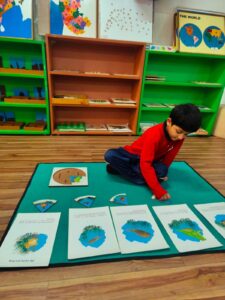
A four-year-old sits on the floor, turning a wooden piece over and over. It does not fit. They try another angle. Still no. Then, with a small click, it slides into place, and a big smile spreads across their face.
That moment contains a lot of learning. Puzzles may look like simple play, but they give young children a powerful workout for the brain, hands, and patience. Here is how puzzles support development in the preschool years, and how to choose and use them well.
Why Puzzles Are So Good for Young Brains
When a child solves a puzzle, many parts of their brain work together. They look closely at shapes and colors, think about where a piece might go, test their idea, and adjust when it does not work. This blend of seeing, thinking, and doing is exactly the kind of practice a growing brain needs.
8 Ways Puzzles Support Development
1. They build problem-solving skills
Puzzles teach children to think, try, and try again. A child learns to look at the problem, make a guess, check it, and change their approach. This trial-and-error process is the heart of problem-solving.
2. They strengthen fine motor skills
Picking up, turning, and fitting pieces builds the small muscles in the fingers and hands. This hand strength supports later skills like holding a pencil, using scissors, and buttoning clothes.
3. They improve hand-eye coordination
Children must look at a piece, judge where it belongs, and guide their hand to the right spot. This links what they see to how they move.
4. They develop visual and spatial awareness
Puzzles help children understand shapes, sizes, and how parts fit into a whole. This spatial thinking supports early math and, later, skills such as geometry and reading maps.
5. They build memory
Children remember what a shape looks like, where a piece was tried, and what the finished picture should be. Practicing this strengthens short-term memory.
6. They grow concentration and patience
Solving a puzzle takes sustained attention. Children learn to stay with a task, work through frustration, and finish what they started, which is a skill that supports all kinds of learning.
7. They boost language and vocabulary
Talking about puzzles brings new words into play: corner, edge, curved, straight, top, bottom, bigger, smaller. Puzzles with animals, vehicles, or letters introduce more vocabulary naturally.
8. They build confidence and resilience
Each completed puzzle gives a child a real sense of achievement. They also learn that hard things can be done with effort, which builds a growth mindset.
Puzzles for Each Age and Stage
The right puzzle is challenging enough to be interesting, but not so hard that the child gives up.
- Around 1 to 2 years: Simple knob puzzles or chunky wooden puzzles with 1 to 4 pieces.
- Around 2 to 3 years: Wooden or foam puzzles with 4 to 12 pieces and clear, simple pictures.
- Around 3 to 4 years: Floor puzzles and jigsaws with 12 to 24 pieces, as well as shape-sorting and matching puzzles.
- Around 4 to 5 years: Jigsaws with 24 to 50 pieces, simple mazes, tangrams, and picture sequencing puzzles.
- Around 5 to 6 years: Bigger jigsaws, number and letter puzzles, and simple logic puzzles.
Every child is different, so use these ranges as a guide rather than a rule.
Types of Puzzles to Try
- Knob and peg puzzles: Easy to grip, ideal for the youngest children.
- Jigsaw puzzles: Classic puzzles that build patience and visual skills.
- Shape sorters and inset puzzles: Teach shapes and matching.
- Number and alphabet puzzles: Support early math and literacy.
- Floor puzzles: Large pieces for group play and teamwork.
- Tangrams and pattern blocks: Build spatial thinking and creativity.
- Maze and matching games: Develop focus and visual tracking.
Puzzles in the Montessori Classroom
In Montessori classrooms, puzzle-like materials are used throughout the curriculum. Wooden puzzle maps, inset shapes, and geometric materials invite children to explore, compare, and discover. Because the materials are hands-on and often “self-correcting,” children can see for themselves whether they have found the answer. That builds independence and a quiet confidence that does not rely on an adult to say, “Well done.”
Tips for Parents
- Start simple. Choose a puzzle your child can finish with a little effort, so they feel successful.
- Let them lead. Resist the urge to do it for them. Offer a gentle hint only if they are really stuck, such as “Try looking for the corner pieces.”
- Make it a routine. Ten to fifteen minutes of puzzle time a few times a week is plenty.
- Work together sometimes. Doing a puzzle side by side models strategies and creates connection.
- Talk about it. Ask, “Where do you think this piece goes?” or “What color do you see on the edge?”
- Celebrate effort. Praise persistence, not just completion.
- Rotate puzzles. Keep a few on a low shelf and swap them out to keep interest high.
- Check for safety. Make sure pieces are large enough for your child’s age, and watch younger children closely with small pieces.
Final Thoughts
Puzzles are one of the simplest and most effective learning tools for young children. Each piece placed builds problem-solving, patience, coordination, and confidence, all while your child is having fun.
At Brainy Stars, hands-on learning is at the heart of our Montessori-based holistic approach. If you are looking for a preschool in Bangalore where children learn by exploring, thinking, and doing, we would love to welcome you for a visit.